


The most sustainable office isn’t the one with the most plants. It’s the one that doesn’t get gutted again in three years.
Most conversations about sustainable office design start and end with materials that look green – reclaimed wood, a living wall, low-VOC paint. All good choices. None of them are where most of a fit-out’s environmental impact happens.
That happens earlier, and it’s less photogenic. It happens in what gets demolished before the new design even starts, and in what gets specified without much thought about whether it will still be useful the next time the layout changes.
What Actually Goes in the Skip Bin
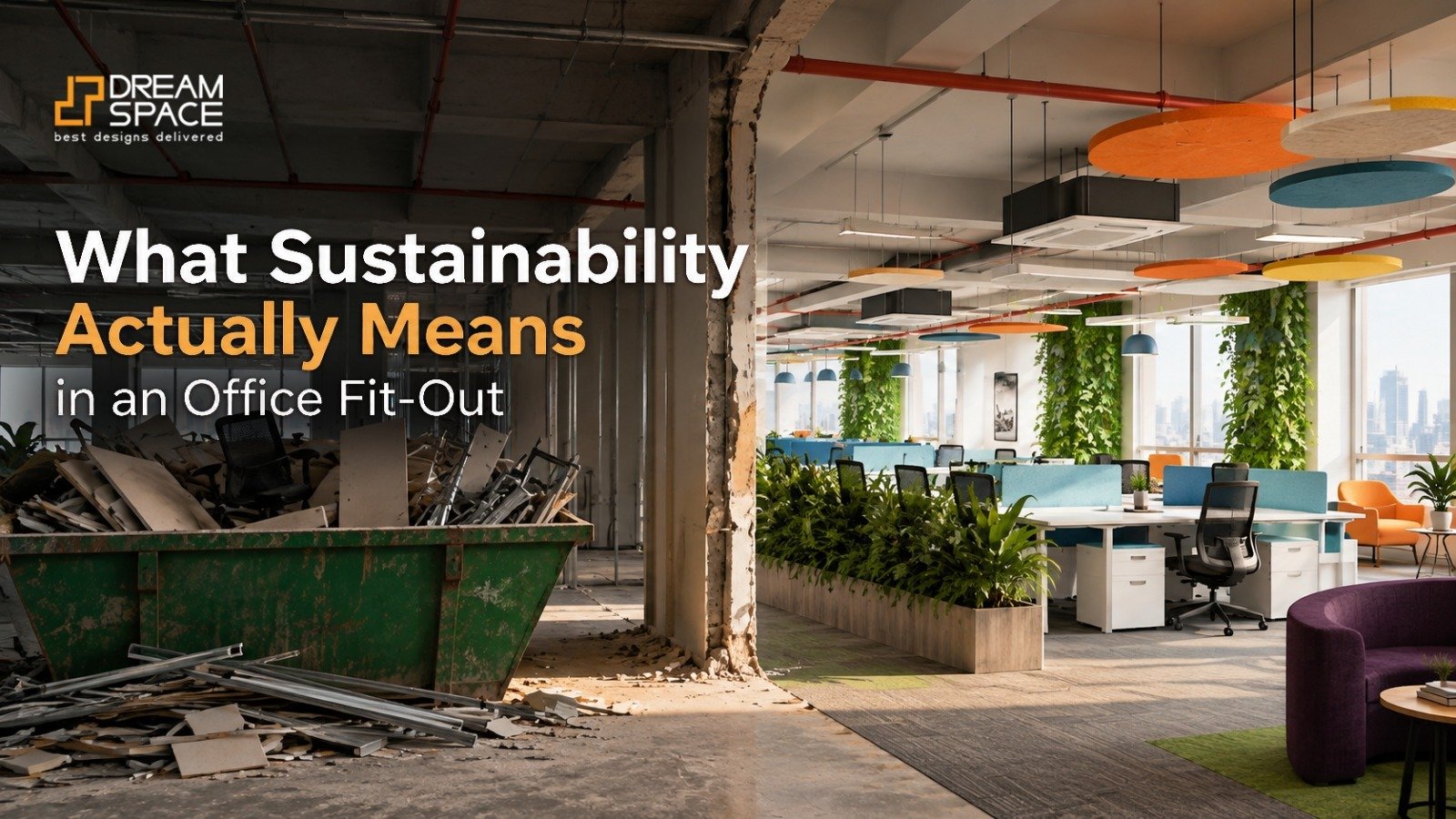
Walk through a strip-out, the demolition phase before a new fit-out begins, and you’ll see a more honest sustainability story than any brochure tells.
Partition walls that were structurally sound, removed because the layout changed. Workstations replaced, not because they broke, but because a rebrand wanted a different finish. Carpet tiles rated for a fifteen-year lifespan, torn out after four because a lease turned over.
India generates an estimated 150 to 500 million tonnes of construction and demolition waste every year, according to the Ministry of Housing and Urban Affairs, and only a small fraction of it is recycled. Commercial fit-outs are part of that number. Unlike a plant wall, that waste is invisible by the time anyone moves into the finished space. Nobody photographs a skip bin for the case study.
Where the Real Levers Are
Durability over decoration. A material that lasts fifteen years and gets used for fifteen years has a smaller footprint than a “sustainable” material that gets ripped out in three. Lifespan is the calculation that usually gets skipped.
Design for disassembly, not demolition. Partitions that unbolt and relocate. Furniture systems that reconfigure instead of getting replaced when a brand refresh happens. The goal isn’t to avoid ever changing the space. It’s to make change something you rearrange, not something you send to landfill.
Specify for the actual lease cycle. Choose materials rated to outlast a five-year lease, not materials that look right for the launch and start showing wear well before the lease is up.
Divert waste during construction, not just after. Work with vendors and contractors who reuse offcuts, separate waste streams on-site, and treat construction waste as a line item to manage, not an afterthought once the dumpster is full.
Prioritise operational efficiency, which outlasts the finishes. Lighting, HVAC zoning, and insulation choices made at fit-out stage affect energy use for the life of the lease. That is usually a far bigger sustainability lever than any single material, and it’s invisible in a walkthrough photo.
Why “Sustainable” Gets Reduced to Plants
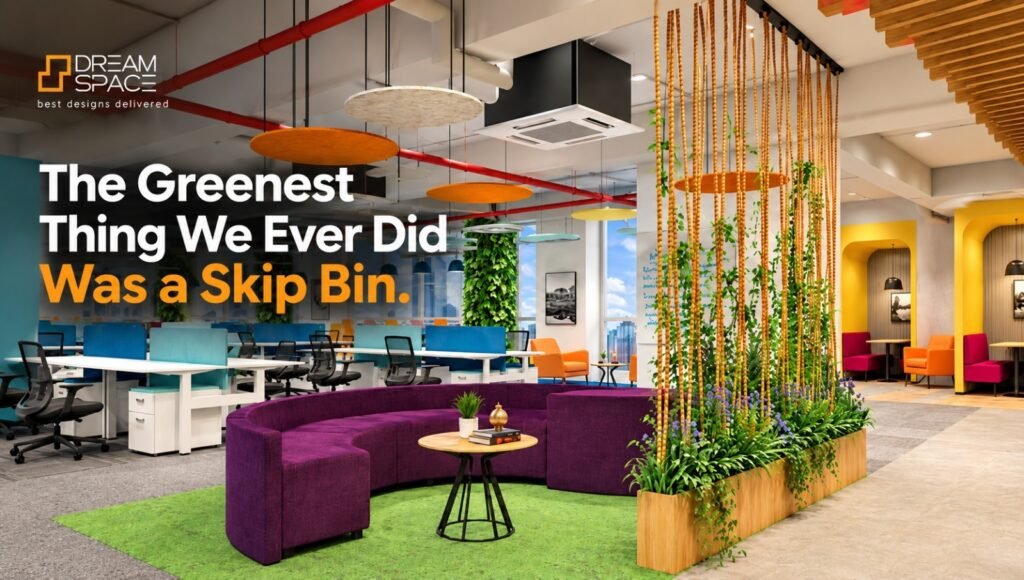
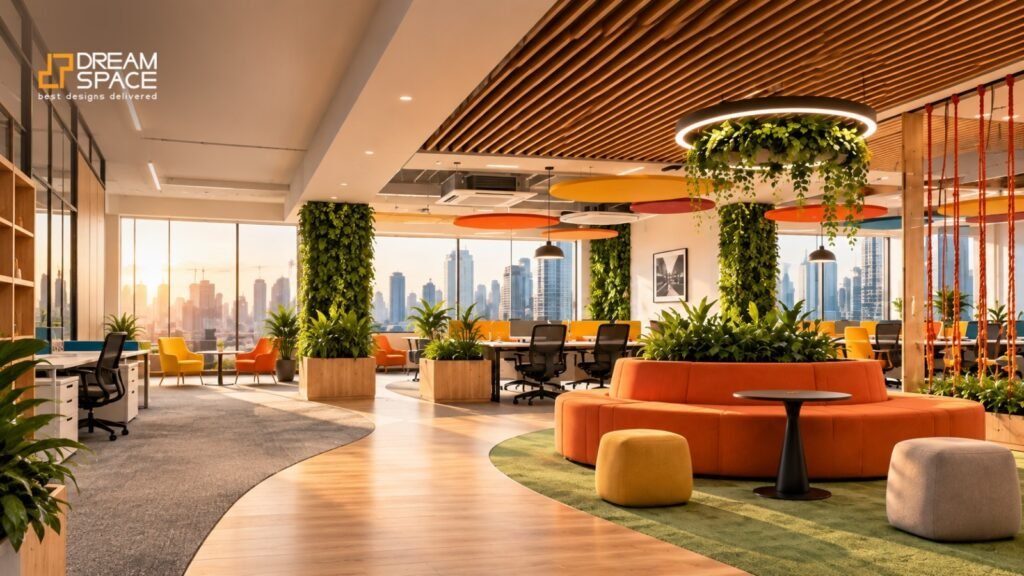
Plants are sustainable, as you can see in a single photo. Durability, waste diversion, and energy efficiency aren’t – they show up over years, in numbers nobody’s usually tracking. That makes them easy to skip in a brief and easy to leave out of a pitch, even when they matter more.
Greenery is wrong. It’s just the visible part of the story standing in for everything you can’t see.
How We Approach It
- Ask what’s being demolished and why. Not every wall that’s “in the way” of a new layout needs to come down. Sometimes the layout can work around what’s already structurally sound.
- Specify for the next tenant, not just this one. Choose materials and systems that can move, not just materials that look sustainable on handover day.
- Track waste diverted, not just waste produced. Know what’s being reused, resold or repurposed instead of binned. It’s a number worth asking your fit-out partner for directly.
- Treat energy efficiency as core scope, not an add-on. Make lighting and HVAC decisions early, as part of the design brief, not as a retrofit.
- Choose partners who’ll say no to unnecessary demolition. Even when tearing something out would be the easier, faster sell.
The Mistakes We See Most
Treating greenery as the whole strategy. A few planters don’t offset a full strip-out of structurally sound partitions three years into a lease.
Specifying for the render, not the lease term. Finishes chosen to look right in the handover photos, not to survive the years the space actually needs to function.
No visibility into where the old fit-out went. Most companies never ask what happened to their previous office’s materials. Most contractors never volunteer the answer.
Confusing “new” with “better.” A full re-fit isn’t automatically the sustainable choice over reconfiguring what’s already there – it’s often the opposite.
The Question Worth Asking Your Next Fit-Out Partner
Not “what sustainable materials do you use” – most firms have a good answer to that one ready.
Ask instead: what happens to what you’re replacing? And will what you’re building for me still be useful the next time someone wants to change the layout?
The answers tell you more about the actual sustainability of a fit-out than any material spec sheet does.
We help teams think through exactly this – talk to us about your next fit-out, or find more of this kind of breakdown on LinkedIn, where we recently asked what “sustainable office” actually means to people – the results say a lot about how this conversation usually gets framed.